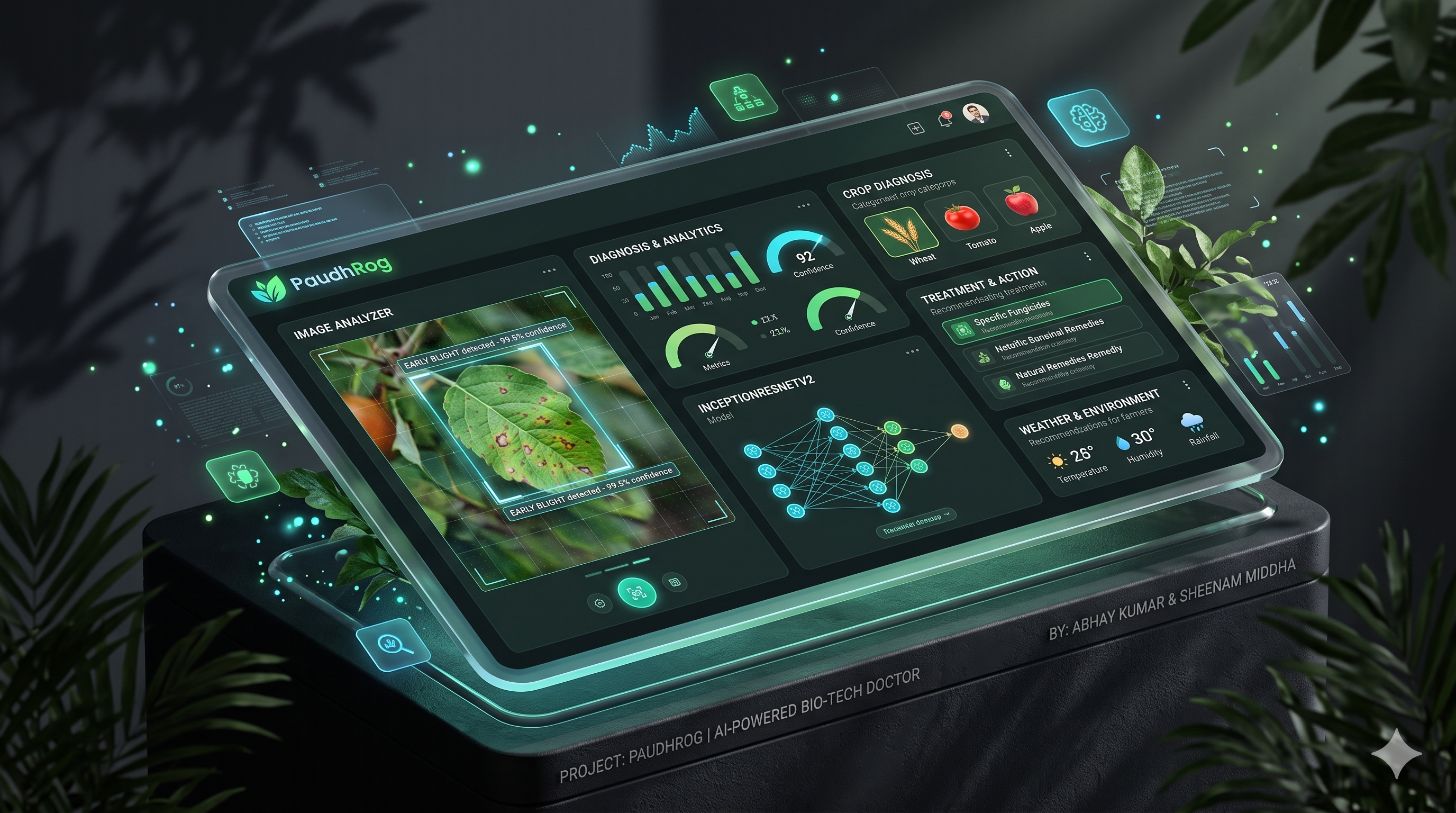
What this project brings together
PaudhRog pairs a transfer-learned leaf-image classifier with a Flask prediction route and treatment suggestions, with the research also addressing class imbalance.
Problem
Spotting a plant disease early from a leaf is hard without an expert.
Implementation approach
Transfer learning on InceptionResNetV2, trained on the PlantVillage dataset, served through a Flask /predict route that returns the disease class with treatment suggestions. The research also documents oversampling and undersampling to address class imbalance.
How the experience works
A step-by-step view of the product flow, using the features and components documented for this project.
- STEP 01Provide a leaf imageThe workflow begins with an image of a plant leaf.
- STEP 02Prepare the imageImage preprocessing prepares the input for the transfer-learning model.
- STEP 03Run InceptionResNetV2The documented model uses InceptionResNetV2 transfer learning on the PlantVillage dataset.
- STEP 04Serve the predictionA Flask /predict route serves the model output to the web application.
- STEP 05Present the resultThe application returns a disease class with treatment suggestions.
My contribution
Implemented the InceptionResNetV2 transfer-learning pipeline in TensorFlow, including the oversampling and undersampling strategy used to correct class imbalance across the PlantVillage set, and built the Flask serving layer and web interface around it. Co-authored the manuscript, drafting the methodology and results sections.
Architecture at a glance
This diagram summarizes the documented system boundaries. The walkthrough above explains the user and processing flow in more detail.
- ClientWeb UIWeather widget
- ServerFlask app/predict route
- ModelPreprocessingInceptionResNetV2
- DataPlantVillage dataset
Leaf image in, disease class out. Transfer learning over InceptionResNetV2, served through Flask.
Trade-offs & constraints
These are practical implications of the architecture described in the supplied project notes, not claims about a formal design review.
- Transfer learning reuses the InceptionResNetV2 representation rather than training an image model from scratch. The model's depth and size still need to be considered when packaging and serving inference.
Key features
- Image-based disease detection
- Treatment recommendations
- Multi-crop support